LaTeX drawings in the exercises
A formula MathJax cannot draw — a reaction with mhchem, a molecule with chemfig, a limit set at full height, a TikZ plot — is drawn by LaTeX itself, and an exercise may hold one as a document does: the LaTeX drawings of the dialect, in two forms.
[…]{latex}, in a line.- A mark that draws what is between the brackets right where it stands, sized to the words round it and set on their baseline. It goes wherever an exercise shows text: the prompt, the sentence of a fill-in, every option, block and entry, both sides of a matching pair, the statements of a yes-no exercise, the explanations. A word after
latexnames a theme,[\ce{H2O}]{latex chemistry}; no word is the default theme. ::::latex … ::::, on its own.- A block on lines of its own, with
{width= align=}if it wants them. It stands in a multi-line prompt (prompt: |) and in the four fields of a Jolly card, and has four colons so that the exercise does not end where the drawing does. Anywhere else — an option, an explanation, the sentence of a fill-in — its lines stay as text: write those with a mark. A block is part of the prompt, not a field of its own: written on its own lines between the fields, straight after a one-lineprompt: …or among the rows, it belongs to no field and the exercise is refused (a LaTeX drawing goes inside the prompt, not between the fields). Writeprompt: |and put every line of the prompt under it, indented, the drawing’s fences and its LaTeX too.
In a step of a follow-up a block has one colon more, like every fence in it: :::::latex chemistry … :::::. In the editor’s preview, ✎ on a block in a prompt or in a step opens it again and rewrites it where it stands, indented and fenced as it was.
Both are drawn once, by LaTeX, and the page, the PDF and a deck show the same picture. What the learner drags, chooses or matches is the option’s own LaTeX, never its picture: Check exercises compares what was written.
1. In a sentence, in the blanks, in the options#
A fill-in whose sentence holds drawings, and whose blocks are drawings too. It has two blanks, each named, and each blank’s row says which block goes there; the two others fit neither. Drag a block into a blank, or click a blank and choose from its cloud, as in any fill-in.
:::exercise fill-blanksprompt: Drag the blocks into the blanks.text: [$\displaystyle\lim_{x\rightarrow 0}\frac{\sin(x)}{x} = $]{latex} [[first]], [$\displaystyle\lim_{x\rightarrow\infty}\frac{1}{x} = $]{latex} [[second]]- [first] [$1$]{latex}- [second] [$0$]{latex}- [ ] [$2$]{latex}- [ ] [$\infty$]{latex}::: ,

The options of a choice exercise are drawn the same way:
:::exercise choose-allprompt: Choose every entry that computes to 1.- [x] [$\displaystyle\lim_{x\rightarrow 0}\frac{\sin(x)}{x}$]{latex}- [ ] [$2 + 2$]{latex}- [x] [$4 \cdot 0.25$]{latex}:::2. Chemistry#
mhchem’s \ce{…} writes a formula or a whole reaction, and the chemistry theme has it. Here the options are reactions, and so is the explanation:
:::exercise single-choiceprompt: Which equation is balanced?- [ ] [\ce{H2 + O2 -> H2O}]{latex chemistry}- [x] [\ce{2H2 + O2 -> 2H2O}]{latex chemistry}- [ ] [\ce{2H2 + O2 -> H2O}]{latex chemistry}explanation-correct: Each side has four atoms of hydrogen and two of oxygen: [\ce{2H2 + O2 -> 2H2O}]{latex chemistry}.::: .
Both sides of a matching pair may be drawn, or one of them:
:::exercise match-translationsprompt: Match each formula with its name.- [\ce{H2O}]{latex chemistry} => water- [\ce{CO2}]{latex chemistry} => carbon dioxide- [\ce{NaCl}]{latex chemistry} => table salt:::


3. A drawing on its own#
A structural formula is a drawing rather than a piece of a line, so it is a block — in the prompt, which is then written prompt: | with its lines indented under it. chemfig draws it, with the same chemistry theme:
:::exercise single-choiceprompt: | Which molecule is this? ::::latex chemistry \chemfig{H-C(-[2]H)(-[6]H)-C(-[2]H)(-[6]H)-O-H} ::::- [x] ethanol- [ ] methanol- [ ] ethaneexplanation-correct: Two carbon atoms and an OH group: ethanol, [\ce{C2H5OH}]{latex chemistry}.:::Which molecule is this?
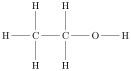
 .
The block’s own LaTeX is written as it would stand between \begin{document} and \end{document}, so a formula in it keeps its $ signs:
:::exercise single-choiceprompt: | Choose the correct answer. ::::latex $\displaystyle\lim_{x\rightarrow 0}\frac{\sin(x)}{x} = ?$ ::::- [x] 1- [ ] 2- [ ] 0:::Choose the correct answer.

On a Jolly card a block may stand in any of the four fields, and a mark in any line of them:
:::exercise flashcardcard-type: jollyfront-primary: | ::::latex $\displaystyle\lim_{x\rightarrow 0}\frac{\sin(x)}{x}$ ::::back-primary: 1:::
:::exercise flashcardcard-type: jollyfront-primary: | ::::latex chemistry \chemfig{*6(-=-=(-[:30]O-[:-30]C(-[:30]CH_3)=[:-90]O)-(-[:90]C(-[:30]OH)=[:150]O)=)} ::::front-secondary: What is it called?back-primary: aspirinback-secondary: acetylsalicylic acid, [\ce{C9H8O4}]{latex chemistry}:::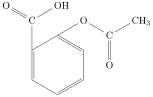

4. When it cannot be drawn#
A drawing needs TeX on the computer Parseh runs on. Where there is none, or where the LaTeX has a fault, the exercise still works:
- A block
- shows its LaTeX in a frame, with one line saying why.
- A mark
- shows its LaTeX where it stands, in code, with no frame.
- On paper
- a block is a framed note, and a mark is set in typewriter type.
The reasons, and what mends each, are in LaTeX drawings.